Changing world state
Record when a property becomes true, stops being true, or is replaced by a later fact.
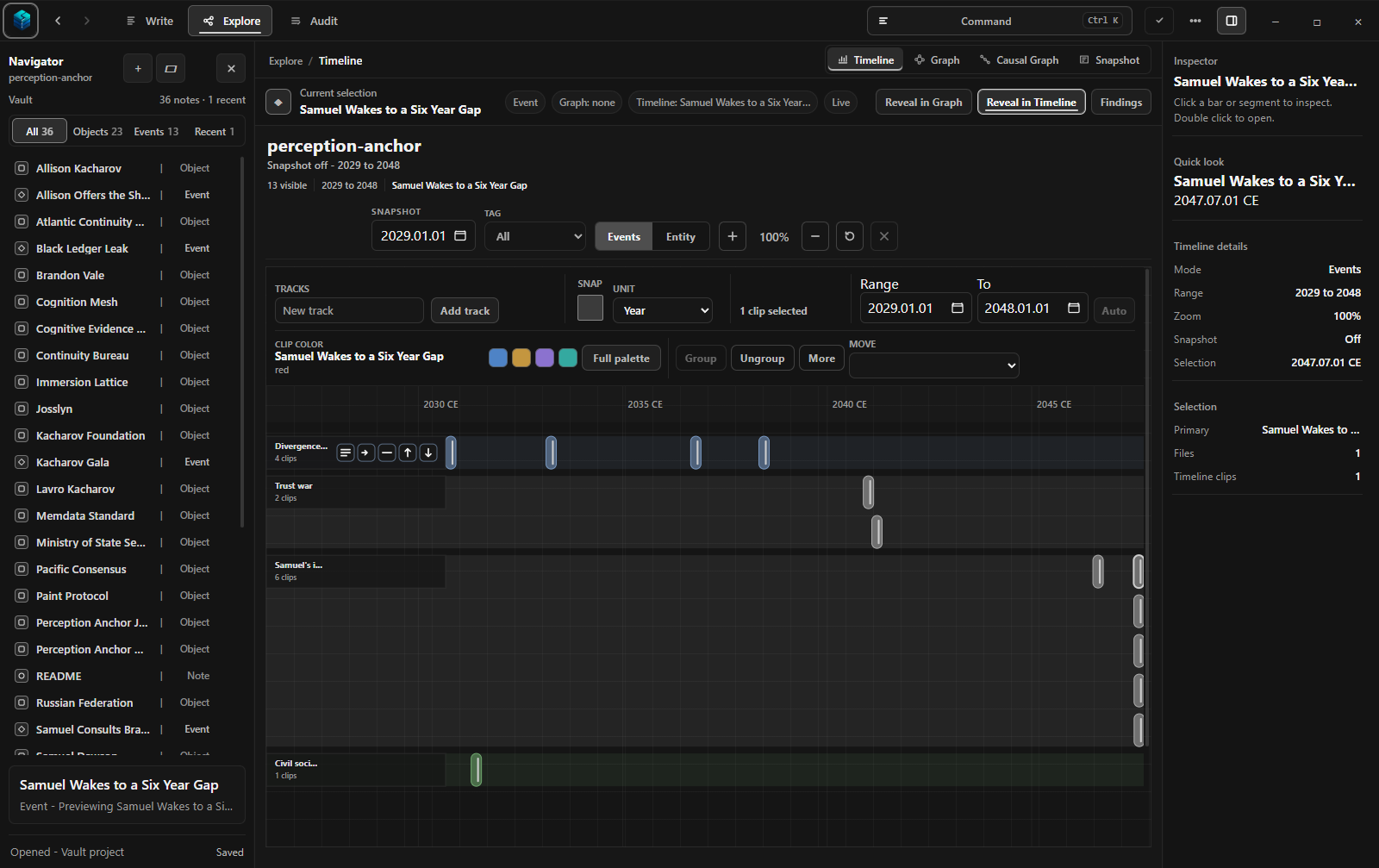
Chronal Studio is story timeline software for writers, worldbuilders, and narrative designers working with complex temporal information. It connects prose, events, changing facts, character knowledge, and causes so you can inspect the same story as a timeline, graph, or point-in-time snapshot.
Dates are only one part of continuity. A character can act on knowledge they have not learned yet, an object can appear in two places, or a current fact can accidentally be treated as though it was always true.
Chronal preserves writing as writing. Structure is proposed or added deliberately, reviewed by you, and reused across every view instead of copied into separate planning documents.
Keep chapters, research, and world notes in readable Markdown files.
Approve the people, dates, events, facts, and relationships worth tracking.
Read the chronology, reconstruct a moment, or trace a consequence back to its source.
Chronal Studio is a desktop temporal reasoning workspace for modeling events, state, knowledge, causality, and change over time.
Record when a property becomes true, stops being true, or is replaced by a later fact.
Separate what the story treats as objectively true from what an individual character knows or believes.
Link events with explicit cause-and-effect claims instead of treating every nearby event as causal.
Reconstruct the state of the fictional world at a selected date from the changes recorded before it.
Use the same approved facts and events in timelines, graphs, snapshots, queries, and source traces.
Direct answers about this workflow and where Chronal fits.
Timeline software for writers organizes story events by when they happen, often across characters, places, and plotlines. Chronal goes further by recording how facts and character knowledge change, then reconstructing the story world at a selected point in time.
Yes. Chronal keeps an entity’s knowledge or belief separate from the project’s objective state. That makes it possible to ask who knew what at a particular point without treating every belief as true.
Chronal can expose conflicting, overlapping, or malformed temporal records and helps a writer inspect what was true at a chosen date. It supports continuity review; it does not replace the writer’s judgment.
No. Chronal keeps prose in ordinary Markdown and adds reviewed temporal structure beside it. Writers can keep normal authoring as the foundation of the project.
Explore how Chronal connects ordinary writing, reviewed temporal structure, and source-traceable answers.