
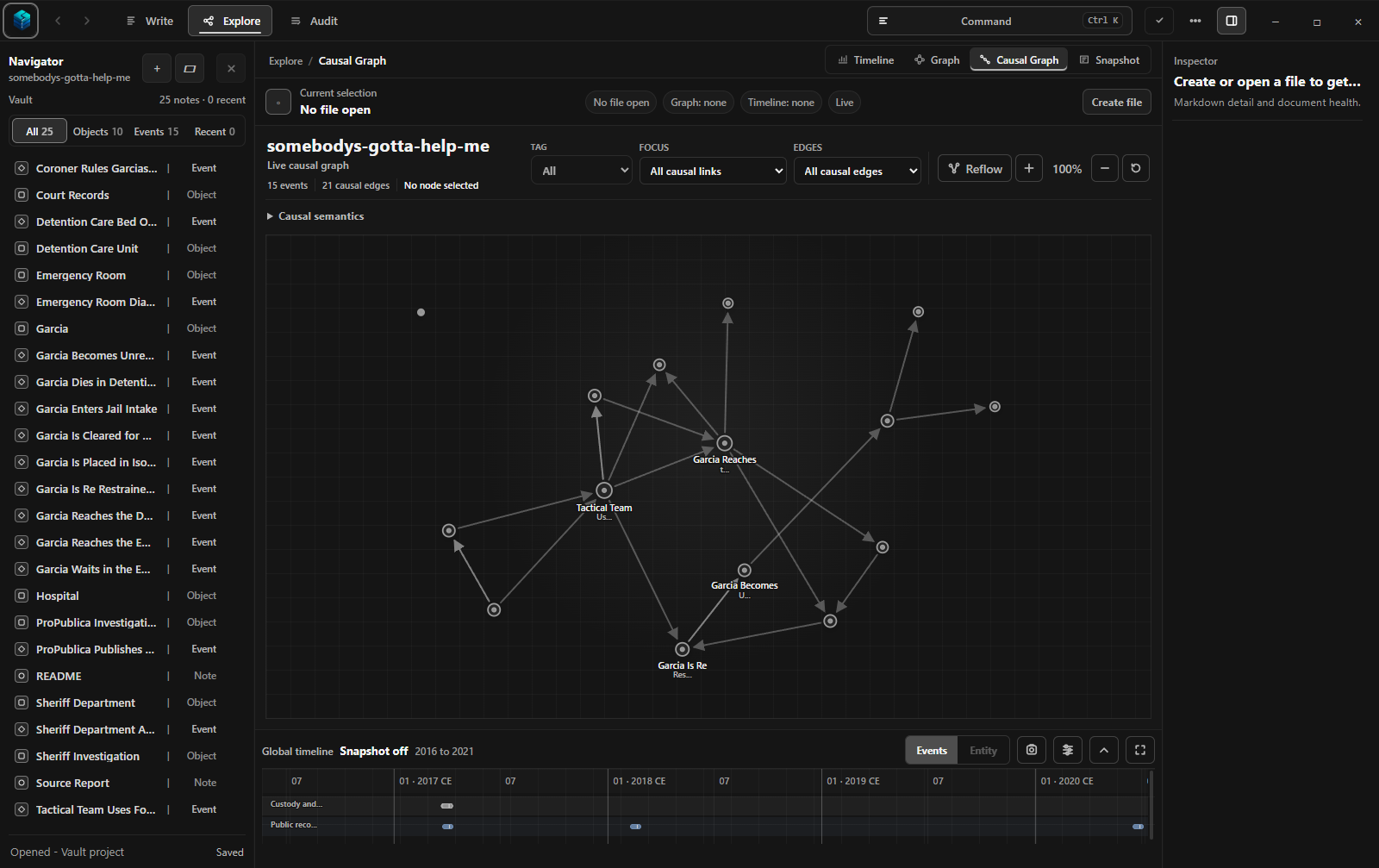
Explicit causal edges
Represent a claim that one event caused another or changed a fact.
Chronal Studio is causal timeline software for writers, researchers, and investigators who need to model both when events happened and how one event or condition is claimed to lead to another. It displays causal claims separately from ordinary relationships and keeps them connected to their source records.
Two events can occur next to each other without one causing the other. A useful causal chronology needs to show sequence, distinguish relationships from causal claims, and preserve the evidence or authored source behind each claim.
Chronal combines dated events, state changes, and explicit causal edges. Each view reads the same reviewed information, so the timeline and causal graph do not drift into separate versions of the project.
Capture what happened, when it happened, and which project state changed.
Link a cause to an effect explicitly; do not rely on visual proximity or sequence alone.
Follow the directed graph, return to the chronology, and open the supporting record.
Directed causal links shown apart from ordinary relationships
Source: ProPublica’s “Somebody’s Gotta Help Me”, by Thalia Beaty, Ryan Gabrielson, Nadia Sussman, and Lucas Waldron. Chronal is not affiliated with or endorsed by the publisher.
Chronal Studio is a desktop temporal reasoning workspace for modeling events, state, knowledge, causality, and change over time.
Represent a claim that one event caused another or changed a fact.
Calculate which facts, knowledge records, and relationships applied at a selected moment.
Explore general connections without silently treating every link as causation.
Open the record behind an answer, see when it applied, and inspect what it replaced.
Ask a guided or precise question and save useful investigations with the project.
Direct answers about this workflow and where Chronal fits.
Causal timeline software combines chronology with explicit claims about which events or conditions led to other events or changes. Chronal keeps these claims distinct from ordinary relationships so they can be inspected rather than inferred from proximity.
No. Chronal records and visualizes causal claims supplied or approved by the user. It helps you inspect those claims and their sources; it does not prove causation automatically.
Yes. Chronal provides a general relationship view and a separate cause-and-effect view. This prevents a connection between two records from being mistaken for a causal claim.
Chronal keeps source information with approved facts and events. A source trace can show where an answer came from, when it applied, and which earlier record it replaced.
Explore how Chronal connects ordinary writing, reviewed temporal structure, and source-traceable answers.