
Keep the Markdown. Add a model of change.
Chronal Studio is an Obsidian alternative for writers, researchers, and worldbuilders whose notes must answer temporal questions—not merely link to one another. Keep a local, readable foundation while adding native snapshots, changing prose and facts, knowledge semantics, causality, and source-aware queries.
Why choose Chronal?
Chronal turns chronology into a model you can inspect and question.
- Make time part of the model.
Prose, facts, relationships, knowledge, and causes carry temporal meaning—not merely date properties.
- Reconstruct instead of searching manually.
Choose a date and Chronal resolves the state that applied at that moment.
- Keep conclusions reviewable.
Proposed structure is validated and accepted before it becomes project truth.
- Stay grounded in local files.
Readable Markdown remains the durable base for writing and structured temporal work.
Product and ownership.
Compare the application model as well as the feature set: how you pay, where projects live, what works offline, and how portable the underlying files remain.
| Product detail | Chronal Studio | Obsidian |
|---|---|---|
| Pricing model | Planned one-time lifetime licenseThe Chronal Studio product model does not require a recurring subscription | Core app is freeSync and Publish are optional paid subscriptions; support licenses are optional |
| Where projects live | Local project foldersWriting and structured temporal data remain on your computer | Local vault foldersNotes and configuration live in a folder on your file system |
| Offline project work | YesProject access does not depend on cloud-hosted project storage | YesLocal vaults remain functional without an internet connection |
| Account dependency | No hosted project accountLicensing is separate from where project data is stored | No account for the core appAn account is needed only for optional services and purchases |
| Project portability | Markdown plus readable sidecarsInspect, back up, and version the complete temporal project folder | Plain-text Markdown vaultNotes remain editable with ordinary text editors and file tools |
Obsidian product details were checked against its official pricing page, data-storage guide, local and remote vault guide. Pricing and service terms can change; the linked official pages are the source of record.
Feature checklist.
Start with the capabilities that make Chronal different. A check means the product provides a dedicated feature; other labels name the closest documented capability.
| Capability | Chronal Studio | Obsidian |
|---|---|---|
| Local, readable Markdown foundation | YesLocal-first project files with structured data beside the writing | YesNotes and properties are stored in local Markdown files |
| Linked notes and relationship graph | YesEntities, relationships, provenance, and graph views | YesBacklinks, outgoing links, and Graph view |
| Dedicated visual timeline of dated events | YesEvents, spans, tracks, filters, and sources share one model | No core timelineRequires a manual convention or community plugin |
| Prose that resolves differently by date | YesTime-bounded Markdown shows the prose applicable at a chosen time | No dedicated featureNotes present their current contents unless versions are maintained manually |
| Point-in-time snapshots | YesDedicated Snapshot workspace | No dedicated featureFile Recovery snapshots restore notes rather than reconstruct project state |
| Reconstruct project state at a selected date | YesResolves applicable facts, knowledge, and relationships | No dedicated featureProperties describe notes without temporal-state semantics |
| Compare project state between two dates | YesSnapshot comparison highlights meaningful changes | No dedicated featureProperties and queries do not reconstruct two historical states |
| Separate objective state from character knowledge | YesKnowledge and belief are time-aware records with distinct semantics | No dedicated featureNotes and properties can imitate a convention but do not understand it |
| Dedicated cause-and-effect graph | YesExplicit causal claims shown separately from ordinary relationships | No dedicated featureGraph and Canvas show links; they do not model causal semantics |
| Trace a temporal answer to its source | YesShows the source, applicable time, and replaced record | No dedicated featureBacklinks navigate notes but do not provide answer provenance |
| Freeform canvas and broad plugin ecosystem | Not the focusA bounded temporal workspace with reviewable workflows | YesInfinite Canvas plus core and community plugins |
Obsidian capabilities were checked against its official documentation for core plugins, Canvas, Bases, properties. “No dedicated feature” means the capability is not documented as a dedicated Obsidian feature; it does not claim that no custom setup or workaround is possible.
Turn dated notes into temporal answers.
Obsidian gives you excellent primitives for shaping a personal knowledge system. Chronal supplies the temporal semantics: it knows which fact applied when, who knew it, what changed between dates, which claim was causal, and where an answer came from.
- Changing facts remain queryable across their full history.
- Snapshots reconstruct a chosen date from approved project records.
- Knowledge and belief can diverge from objective project state.
- Queries return answers with applicable time and source provenance.
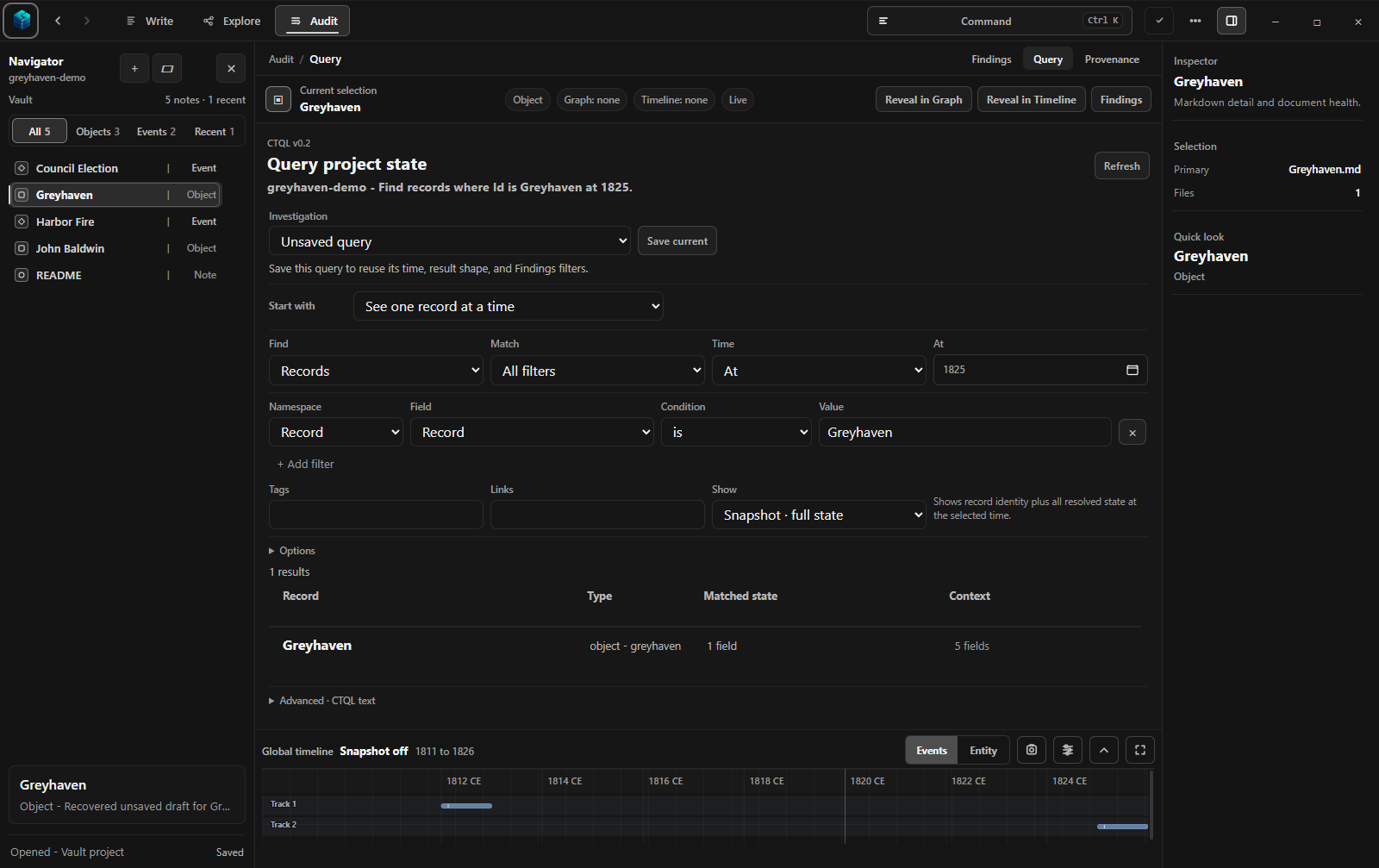
Query results connected to applicable dates and sources
Questions people ask
Direct answers about choosing Chronal as a Obsidian alternative.
Is Chronal Studio an Obsidian alternative?
Yes—for projects where time is part of the data model. Chronal keeps the durability of local Markdown while adding dedicated timelines, point-in-time snapshots, temporal knowledge, causality, queries, and source tracing.
Does Chronal use local Markdown files?
Yes. Chronal projects are local-first and use readable Markdown as their durable foundation, with structured temporal data kept alongside the writing.
Can Obsidian make timelines?
Not as a core temporal model. You can assemble timeline-like views with dates, properties, Bases, Canvas, and community plugins, but Obsidian does not natively reconstruct project state, compare temporal snapshots, distinguish knowledge from truth, or trace causal answers through time.
Does Chronal replace Obsidian for every note-taking workflow?
No. Obsidian is a highly flexible general-purpose knowledge base with an extensive plugin ecosystem and freeform Canvas. Chronal is deliberately specialized for understanding change through time.
Can Chronal track custom fictional time?
Yes. Chronal calendars support custom day duration in hours, minutes, and seconds; custom month counts and lengths; and year numbering with BCE/CE or named numbered ages.
Give your notes a memory of change.
Use local Markdown with a dedicated model for state, knowledge, causality, sources, and time-aware questions.